
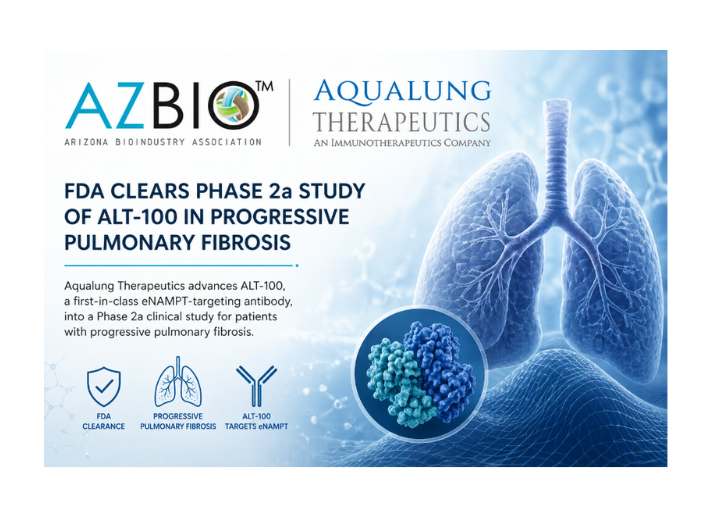
Aqualung Therapeutics Advances ALT-100 into Phase 2a Study for Progressive Pulmonary Fibrosis
Aqualung Therapeutics has received clearance from the U.S. Food and Drug Administration (FDA) to initiate a Phase 2a clinical study of ALT-100, its lead monoclonal antibody targeting extracellular NAMPT (eNAMPT), in patients with progressive pulmonary fibrosis (PPF). The clearance marks an important step in the company’s effort to expand its clinical program beyond acute inflammatory lung injury and into chronic fibrotic disease.
Progressive pulmonary fibrosis remains a serious and often fatal condition, characterized not only by scarring of lung tissue but by persistent inflammation and ongoing injury that drive disease progression. Current treatment options are limited, and many patients continue to decline despite available therapies. Aqualung’s approach is based on the premise that intervening earlier in the inflammatory cascade may help alter the trajectory of disease.
ALT-100 is designed to neutralize eNAMPT, a protein increasingly recognized as a key upstream mediator of inflammation, immune activation, and tissue damage. By targeting this pathway, Aqualung aims to disrupt the cycle of injury and fibrosis that defines diseases like PPF, rather than simply managing downstream symptoms.
The upcoming Phase 2a study, known as the PAISANO trial (Preventing the Advance of Lung Fibrosis via the ALT-100 Antibody), will evaluate the safety, pharmacokinetics, pharmacodynamics, and early signs of efficacy of ALT-100 in patients with progressive pulmonary fibrosis. The study is expected to be conducted across multiple clinical sites and represents the next step in translating Aqualung’s preclinical and early clinical findings into a patient population with significant unmet need.
Notably, the FDA waived the requirement for a prior idiopathic pulmonary fibrosis specific study, citing the strength of Aqualung’s existing data package. This includes preclinical studies demonstrating anti-inflammatory and anti-fibrotic activity, a Phase 1a study in healthy volunteers establishing early safety, and clinical experience in patients with moderate to severe acute respiratory distress syndrome (ARDS). Together, these data supported advancement directly into a Phase 2a study in PPF.
This latest clearance represents Aqualung’s second FDA-approved Investigational New Drug (IND) application for ALT-100, reinforcing the broader potential of its eNamptor platform. In addition to the therapeutic antibody, the platform includes biomarker and genotyping tools designed to better understand disease biology and support more targeted clinical development.
For Aqualung, the move into progressive pulmonary fibrosis reflects a deliberate strategy to apply its science across a range of inflammatory and fibrotic conditions where eNAMPT is believed to play a central role. While the upcoming trial will focus on safety and early signals of activity, it also carries broader implications for how upstream inflammatory targets may be leveraged in complex chronic diseases.
As the PAISANO study moves forward, it will provide the first real test of whether neutralizing eNAMPT can meaningfully impact disease progression in patients living with pulmonary fibrosis. In a space where new approaches are urgently needed, the study represents a step toward expanding the treatment landscape and addressing a significant unmet clinical need.